Previous owners engaged architect Eva Byrne whose design work flooded this D6 house with natural light.
Irish Times, Monday 6 November 2023.
Article about house in Rathgar that I renovated and extended in 2006.

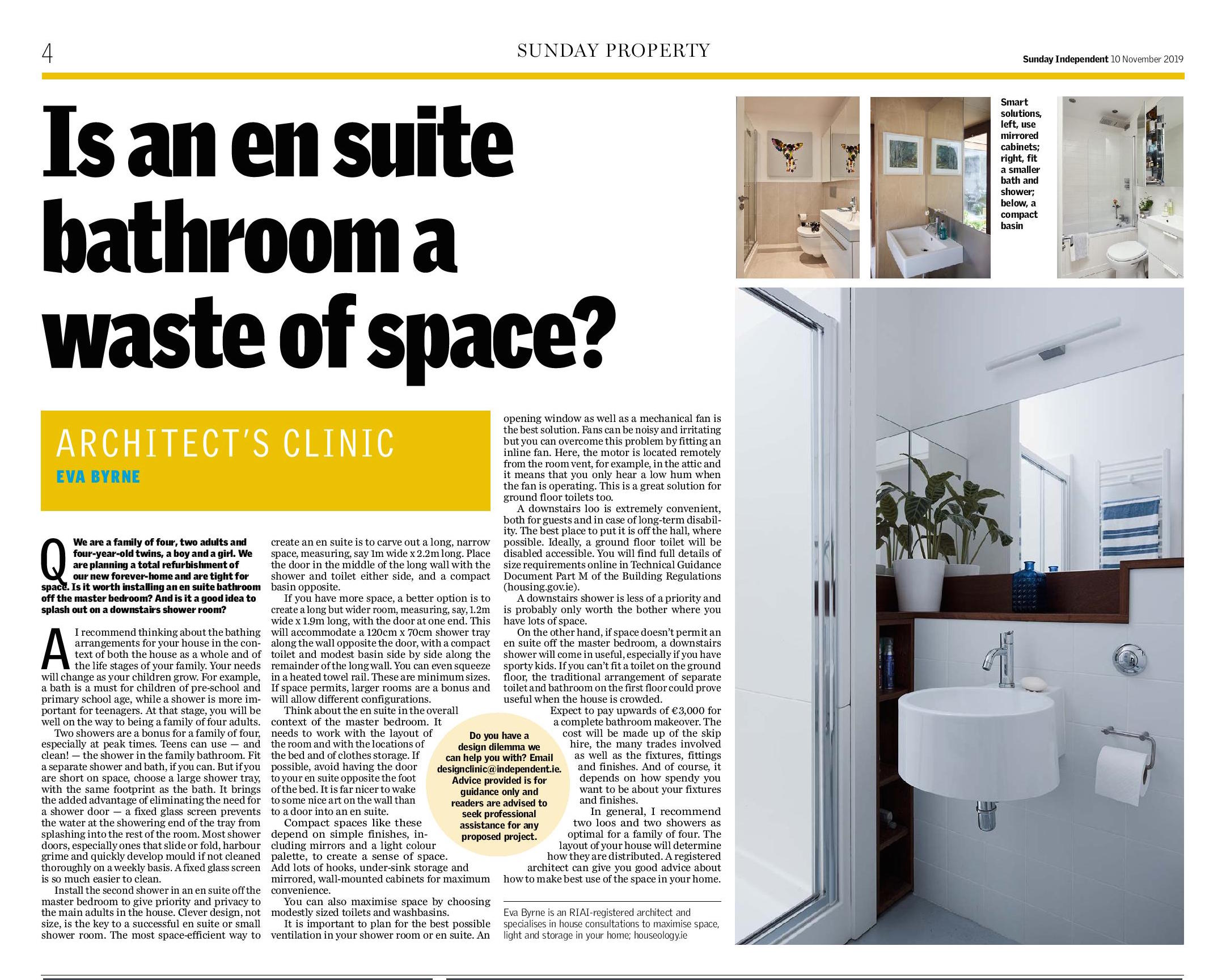
Read the article online in The Sunday Independent.
We are a family of 4, 2 adults and 4 year old twins, a boy and a girl. We are planning a total refurbishment of our new forever-home. Is it worth installing an ensuite bathroom off the Master Bedroom? And is a downstairs Shower Room worth the space and money?
I recommend thinking about the bathing arrangements for your house in the context of both the house as a whole and of the life-stages of your family. Your needs will change as your children grow. A bath is a must for children of pre-school and primary school age. A shower is more important for teenagers. At that stage, you will be well on the way to being a family of 4 adults.
Two showers are a bonus for a family of four, especially at peak times. The teens can use – and clean! – the shower in the family bathroom. Fit a separate shower and bath, if you can. If you are short on space, a large shower tray, with the same footprint as the bath, is a great solution. It brings the added advantage of eliminating the need for a shower door. This is because a fixed, glass screen can prevent the water at the showering end of the tray from splashing into the rest of the room. Most shower doors, especially doors that slide or fold, harbour grime and quickly develop mould if not cleaned thoroughly on a weekly basis. A fixed glass screen is so much easier to clean than any door.
A second shower in an ensuite off the Master Bedroom will give priority and privacy to the main adults in the house. Clever design, not size, is the key to a successful ensuite or small shower room. The most space-efficient way to create an ensuite is to carve out a long, narrow space, measuring, say 1 metre wide by 2.2 metres long. This will be entered in the middle of the long wall. The shower and toilet can be placed to either side of the door, with a compact basin opposite.
A better option is to create a long but wider room, measuring, say, 1.2 metres wide by 1.9 metres long, entered at one end. This will accommodate a 120 by 70 centimetre shower tray along the wall opposite the door, with a compact toilet and modest basin side by side on the remainder of the long wall. You will even squeeze in a heated towel rail. These are minimum sizes. If space permits, larger rooms will be a bonus.
Compact spaces like these depend on simple finishes, including mirrors and a light colour palette, to create a sense of space. Add abundant hooks, under-sink storage and mirrored, wall mounted cabinets for maximum convenience. You can also maximise space by choosing modestly sized toilets and washbasins. It is important to plan for the best possible ventilation in your shower room or ensuite. An opening window as well as a mechanical fan is the optimal solution. Fans can be noisy and irritating but you can overcome this problem by fitting an inline fan. Here, the motor is located remotely from the room vent, for example, in the attic. This means that you only hear a low hum when the fan is operating. This is a great solution for ground floor toilets also.
Think about the Ensuite in the overall context of the Master Bedroom. It needs to work with the layout of the room and with the locations of the bed and of clothes storage. If possible, avoid having the door to the Ensuite opposite the foot of the bed. It is far nicer to wake to some nice art on the wall than to a door into an ensuite.
A downstairs toilet is extremely convenient, both for guests and in case of long-term disability. This is best entered off the hall, where possible. Ideally, a ground floor toilet will be disabled accessible. You will find full details of size requirements in Technical Guidance Document Part M of the Building Regulations. A downstairs shower is less of a priority and is probably only worth the bother where space is abundant. On the other hand, if space does not permit an Ensuite off the Master Bedroom, a downstairs shower will come in useful as the second shower, when needed. If you cannot fit a toilet on the ground floor, the traditional arrangement of separate toilet and bathroom on the first floor could prove useful when the house is crowded.
In general, I recommend 2 toilets and 2 showers as optimal for a family of 4. The layout of your house will determine how they are distributed. Ask your RIAI registered architect for advice about how to make best use of the space in your home.
Eva Byrne is an RIAI Registered Architect. Eva specialises in House Consultations to maximise Space, Light & Storage in your home.
www.houseology.ie
“Striking a balance between practical and cool is tricky when it comes to teen bedroom decor”.
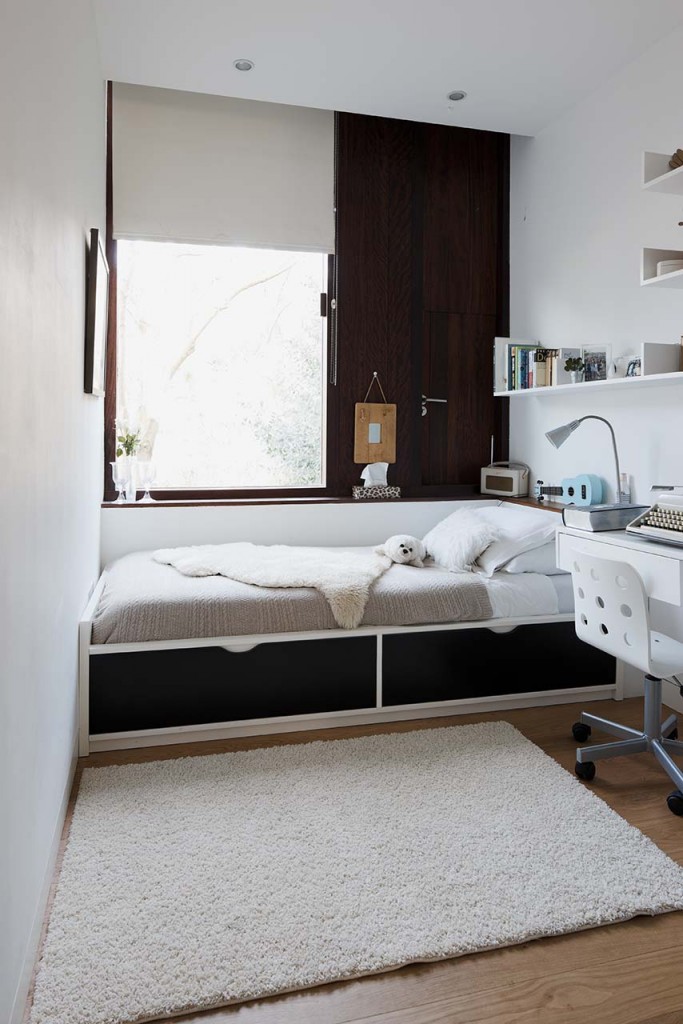
Eleanor Flegg September 13 2019 2:30 AM
I once went up to my teenage son’s bedroom to find him behind the door with a baseball bat, poised and ready to swipe.
“I’m so sorry mum,” he said, lowering his weapon. “I thought you were my brother.” It occurred to me that it was a very good thing that their bedrooms were on different levels: one on the first floor and the other in the attic. Their battles weren’t conducted on the landing.
Interior design for teenagers is often a matter of damage limitation.
“Optimally, a family home will have an open-plan kitchen, dining and living area, and a separate sitting room that can evolve as the family grows,” says Eva Byrne, architect and interiors consultant. When the children are small, you use it to hide from them. When they are teenagers, they use it to hide from you.”

For most teenagers, there are times when the world becomes too much. It’s important to have somewhere to retreat to and, typically, that’s the bedroom. For those with their own room, the décor can express their developing identity.
For those who share, it’s important that the room is laid out so all the occupants have a sense of their own space within the room. If I were a teenager, the swinging Tiipii daybed (from around €350) would be top of my wish list. It’s a cross between an indoor hammock and a nest.
“The key elements of a teen bedroom are a bed, study area, and clothes storage,” Byrne explains. “They will be spending a lot of time in bed, so invest in a good mattress and base. Many teens use their beds not just for sleeping, but also for conducting their online lives. A separate dressing table for a girl is a bonus – study and make-up don’t mix.”
As someone who brought up boys, I would never have thought of that. I do however understand the need for a punch bag.
Grooming products can stain surfaces. Byrne suggests that you choose a dressing table with a top that can be wiped clean, or protect the surface with a sheet of clear or opal glass. Ikea’s Malm dressing table (€115), for example, comes with a ready-made glass top. “A large mirror on the wall above the dressing table, as well as an extending, magnifying mirror and good lighting, will allow thorough inspection from all angles.” Did I mention that she consulted her daughter on this?
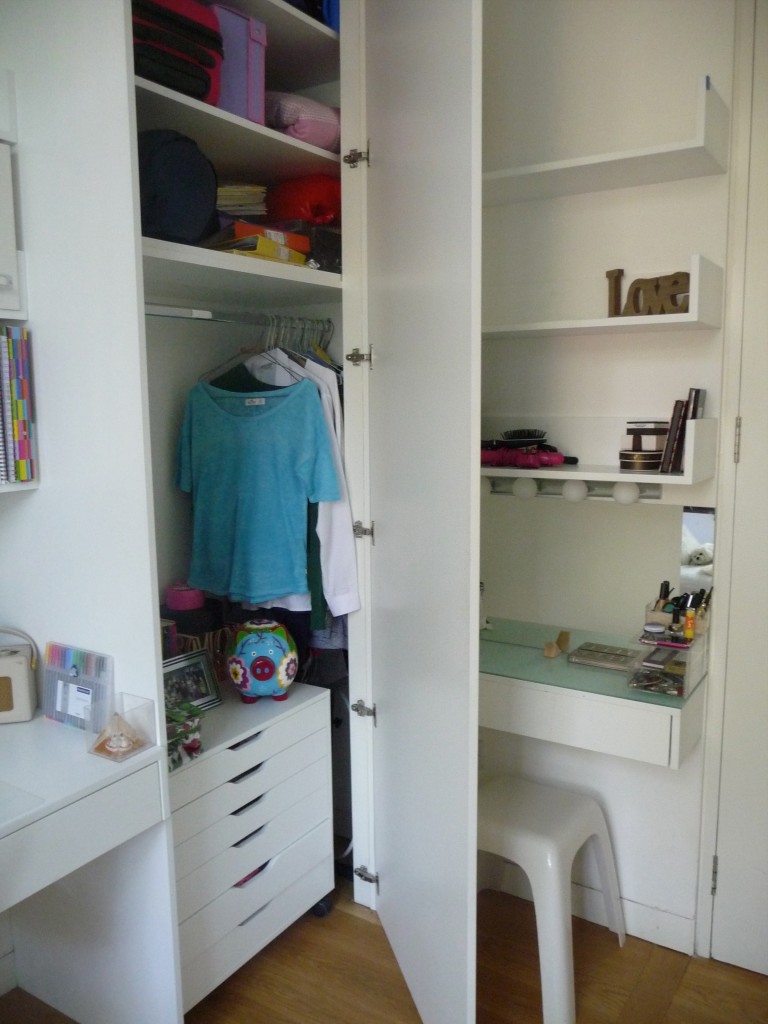
Then there’s the desk. “I recommend getting as large a desk as possible. Despite this being a digital age, most learning still happens with books and paper and pen, so the larger the surface area, the better,” Byrne says. “Both our teens ended up doing their Leaving Cert study on the large, three-metre-long table in the middle of our open-plan ground floor, despite each having a 142cm-long desk in their rooms.” She suggests buying a trestle table, as opposed to a formal desk, because the table top can be cut to suit the size of space available.

Byrne’s other suggestions include a pin-board or white-board on the wall above the desk surface, with shelving above it. “School books tend to be quite large, so make sure the shelves are far enough apart – say 32cm – to fit lever-arch files and books.”
There’s a general assumption that teenagers should study in their bedrooms, but not all of them want to. One of mine liked to study, or pretend to study, in privacy. The other liked to spread his belongings across the kitchen table. We bought a bigger desk for his room, but it didn’t see a lot of use. He didn’t want to be isolated in his room (a lot of design for teenagers is aimed at containing them) and he liked to do homework in company.
“I would hate to study in my bedroom,” says Tara O’Sullivan (aged 17), who is due to sit her Leaving Cert in 2020. Last year, her brother moved away to college, so she uses the desk in his room. I can see her point. I wouldn’t like to work in the same place that I sleep either. The thing that O’Sullivan likes best about her room is her Ikea Hemnes daybed (€479), which can convert from a high-framed single to a double. “I love the flexibility,” she says. “Also, it has lots of storage.”
Shared storage spaces – such as coat hooks or shoe racks in the hall – should be as convenient to use as possible. If they’re not, teenagers won’t use them. And the easier the laundry process, the higher the chance of compliance. “Make laundry baskets accessible, preferably colour-coded for darks and for lights,” Byrne says. “Dirty clothes will generally live on the floor, but at least they can be easily sorted once the teens run out of clean clothes and have no option but to put on a wash. Teens should definitely do their own laundry!”
Then there’s cleaning. It’s increasingly fashionable for teenagers to have their own ensuite bathrooms, which seems like a wild and unnecessary extravagance. But how lovely for the occupying teen! No more fractious queuing on the landing. The parents who have forked out for this luxury often insist that the young person cleans their own bathroom.
Byrne suggests you make this easier on everyone by selecting fittings that are easy to clean and not prone to harbouring mould: hinged, as opposed to sliding or bi-fold, shower doors and small wash basins (the smaller the basin, the less grime it can accrue).
I insisted that both my teenage sons took turns in cleaning our communal bathroom. After this rule was instigated, the elder complained bitterly that he was “the only child in his whole school who was forced to scrub the toilets”. That’s rule number one with parenting teens. You’re never going to get it right.
Eva Byrne is the principal of Houseology, a company that offers consultations on all aspects of interiors (€499 for a two-hour session; see houseology.ie). See also ikea.com and tiipiibed.com.
Indo PropertyRead Eleanor Flegg’s article in including my own thoughts on the matter, here:
The owners of this bijou Dublin flat had one seemingly impossible request for their home’s redesign – they wanted to squeeze in two shower rooms. A family member lives here full-time and the couple stay at weekends and during holidays, so it was important to create two separate bathrooms to make it easy to share the space.
Some smart thinking allowed architect Eva Byrne to not only include the shower rooms for her clients, but also incorporate a utility area.

Flat at a Glance
Who lives here? An Irish couple who live in the countryside part of the time and a relative who lives here full-time
Location Dublin
Property A1970s flat
Size Two bedrooms and two bathrooms
Architect Eva Byrne of Houseology Photos by Philip Lauterbach
The original living space in this Dublin flat was quite dark, consisting of a separate kitchen and living room. Eva removed the division between the rooms to create an open-plan kitchen-diner and living space.

Eva’s clients, who spend most of their time in the countryside, were also keen to add an extra wash-space, as they share their flat with a family member who lives here full-time. So she got rid of the bathroom to incorporate two neat shower rooms and a utility cupboard.

In the kitchen, Eva removed the wall where the washing machine was previously located to create an open-plan living space. “It would have been very difficult to move the boiler in a second-floor apartment,” Eva says, “so we left it in place and covered it with a cupboard.”

Eva asked her builder to construct simple MDF kitchen units that reach the ceiling. Inside, the shelves are adjustable, so the owners can tailor the storage to their needs.
“We chose integrated appliances, as they’re easy on the eye in an open-plan space,” Eva says. “The green glass tiles are reflective and warm, and give some depth to the white kitchen.”
The circular table can accommodate four people and is light enough to be moved around the room. “The single leg is very important in a small space,” Eva says, “as it allows people to sit comfortably around the surface.”

Eva tucked an office area into the space behind the sofa. “The trestle table can be folded away if the owners want to move it,” she says. “The cupboard with opaque doors keeps any junk hidden away.”

In the living room, Eva lined up the sofa, coffee table and TV stand to create an uncluttered, harmonious feel. The monochrome, block-patterned rug anchors the space.
The simple translucent blind rolls up neatly to let in maximum light from the south-facing window.

In the hallway, Eva aimed to create a welcoming and practical space. Cushioned vinyl floor tiles have been laid in here and everywhere else, apart from the bedrooms.
A wall mirror sits above a small shelf and a row of hooks. “Positioning the coat hooks at a lower height is less cluttered than if they’re at eye level,” Eva explains. “They’re hung 1.2m above the floor, as none of our coats are any longer than that.”
A neat picture shelf above the radiator provides a handy surface and doesn’t block the heat.

Previously, the hallway felt a little squashed, with a darker floor and hooks at eye level.

Eva replaced the original four-panelled internal doors with modern ones. The opaque glass allows light to flow through the flat while maintaining privacy.

The master bedroom has a pure wool carpet and a king-size bed with storage below. Two vintage bedside tables with sliding doors are space-saving and prevent the owners knocking into any sharp corners when they get out of bed.

A basin in the original bedroom was removed to create a doorway to the new en suite.
Eva also moved the main bedroom door right up to the corner (see floor plan), which allowed her to widen the fitted wardrobe slightly and created more space in the hallway for a utility cupboard.

The fitted cupboards are a combination of Ikea interiors and bespoke doors. “The wardrobes are 2.3m high, while the ceiling is 2.6m high,” Eva says. “So by fitting full-height doors, we’ve created an extra shelf between the top of the wardrobe and the ceiling.”

In the tiny en suite, Eva had to think carefully about how best to use the space. “Every centimetre had to prove itself,” she laughs.
A shower slots into a recess on the right, while a compact toilet, small basin, and towel radiator are tucked into the area straight ahead.
“Wall hooks are key in a space like this,” Eva says. “In here, there are hooks everywhere – in the shower, on the wall by the basin and on the back of the door.”

A mirrored cabinet above the basin provides useful storage and appears to double the space.
The neat basin features a soap dish and a practical tray where the owners can keep toiletries handy.
“I prefer to tile only halfway up in a bathroom, as it’s nice acoustically to have some plaster,” Eva says.

The doorway in the second bedroom was also moved along to the edge, which made room for a wardrobe with light-reflecting mirrored doors.

As there was only room for one bedside table, Eva installed a picture shelf above the bed. Two clip-on reading lamps have been attached to the ledge.

Another shower room leads off from the hallway and includes many of the same features as the en suite.

“The shower is just 70cm across, but its 120cm length makes it feel quite big,” Eva says.
Once again, hooks provide essential storage. “I’ve been in larger bathrooms that feel quite cramped,” she says, “whereas this room feels spacious, as there’s somewhere to put everything.”

Between the two shower rooms is a useful laundry cupboard, hidden away behind streamlined doors.

The space inside was carefully worked out and is 75cm wide and 60cm deep to accommodate the washing machine. There’s a shelf above the machine for stashing laundry essentials, and a shelf at the top for towels and linen.
Eva also installed a hanging rail 1m higher than the surface, which is enough room for most garments.
Hooks on the back of the door and on the adjacent wall provide extra storage.
Before and after photos show how a smart layout and ingenious design turned a dark space into a bright, welcoming home


Amanda Pollard 12 August 2018
Being a professional house hunter, Breffnie O’Kelly knew this was the perfect house for herself and her teenage daughter – it was close to the school and nearby walks, the road and neighbours were nice, and the house itself had bags of character.
The catch? The inside was dreary and cramped. So Breffnie called on the expertise of architect Eva Byrne of Houseology to make her new home feel light, airy and spacious.
House at a Glance
Who lives here Professional property hunter Breffnie O’Kelly and her teenage daughter
Location Dublin, Ireland
Property Early 20th century terraced house
Size Two bedrooms and one bathroom (55 sq m)
Architect Eva Byrne of Houseology Photos by Philip Lauterbach
Everything about this two-up, two-down cottage said ‘good buy’ to Breffnie O’Kelly and her teenage daughter when they spotted it – everything, that is, except the dark and dreary internal layout.
Luckily, Breffnie could call upon her friend, architect Eva Byrne, to help her with some ideas. “I also work as a house consultant, so this started out as a consultation,” says Eva.
But it wasn’t long before she’d come up with a complete redesign of the property, and Breffnie had commissioned Eva to take on the full project.
At the front of the property, Eva replaced the windows and door and took down the modern railing that surrounded the flowerbed. “We fitted a timber door in a welcoming colour,” she says.

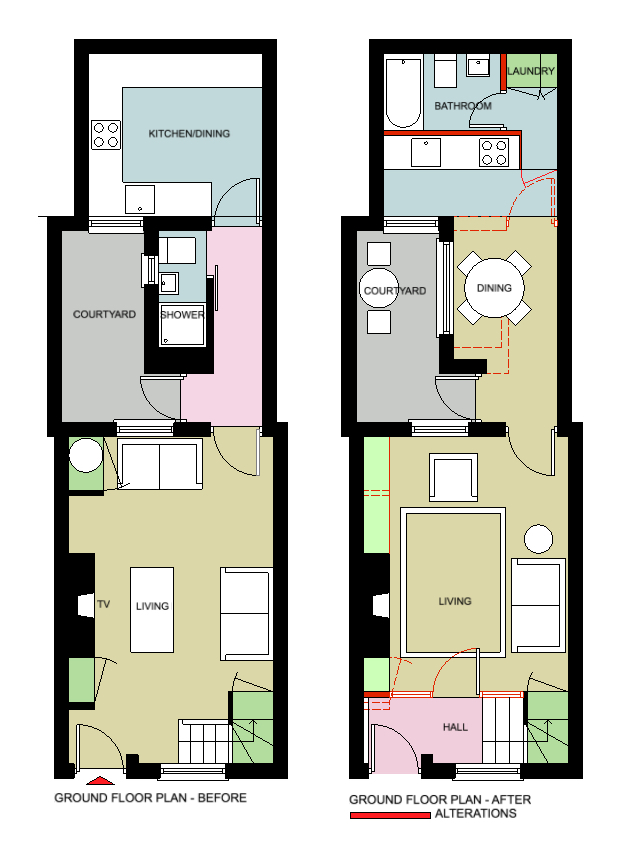
The front door opened straight into the living room, so Eva decided to create a separate hallway.


We fitted a painted timber and glass screen that can fold all the way back,” Eva says. “It gives you privacy from the street when you’re in the living room.“You don’t do anything near the door anyway, so you’re not losing any living space by adding a division,” she adds.
The team put in a ledge with hooks underneath and a round mirror to turn the space into a useful hallway.


The stairs to the right of the door were extended right along to the glazed partition. “It makes the room feel wider,” Eva says. They also painted on a grey runner, which leads you up the steps.
Rather than leave the back of the front door white, Eva chose to add colour. “We painted the door the same shade on both sides to make a feature of it,” she says. “In white, it wouldn’t have worked as well.”
The living room has a simple yet cosy feel, with white walls, recessed spotlights, a soft rug and a comfortable sofa. “The sofa is a neat 180cm wide,” says Eva. “It’s important to size furniture appropriately, so it doesn’t take over the room.”

Eva kept the fireplace minimal, too, with a flush hearth and a plain opening for the wood-burning stove. Storage was built into the chimney alcoves – there’s a bookcase and cabinet to the left.
To the right of the chimney, the team built a bench seat with storage drawers below.

The seat is positioned next to a window, which Eva had lowered to maximise the view of the courtyard and bring plenty of light into the room.
She chose some botanical prints for the walls to further connect the inside with the outside space.
The ‘before’ photo of the living room shows how much darker it was before the window was lowered.

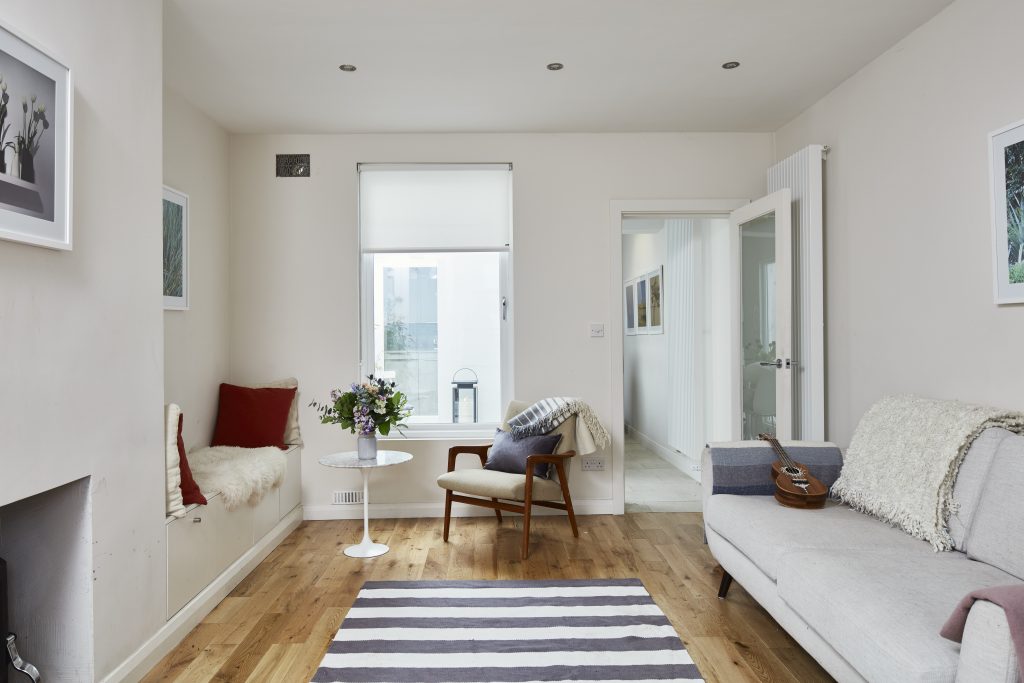

The key to creating a luminous and spacious feel was to connect the living spaces to the courtyard at the centre of the property.
The existing floor plan shows how a shower room was blocking the view. Eva removed it and located an open-plan kitchen-diner in its place, then tucked a bathroom at the back of the property.
A glazed door leads from the living room to the new kitchen-diner. The glass is opaque to allow light in while creating privacy between the two areas.
“As Breffnie’s daughter is a teenager, we thought it was important for her to have her own space,” says Eva. So her design takes into account a separation of each area of the house, so that mother and daughter can enjoy time together and apart.
The shower room had previously blocked access to the courtyard.


Just before you reach the dining area, there’s a glazed door to the courtyard. The large window next to the table can’t be opened, but it helps to bring light and a spacious feel into the home.
Porcelain tiles have been laid on the floor both inside and on the patio to further connect the two areas.
“We wanted the table to have a single leg so you can sit anywhere around it,” says Eva. “Our carpenter made it from a table base and a circle of MDF.”

A row of narrow picture ledges provides enough room for books without encroaching too much on the space.

The previous kitchen took up the entire back room of the house.


The new kitchen is a simple design with painted MDF doors, but Eva used a clever trick to increase storage. “We chose to make the worktop 1m high instead of 90cm,” she says. “This allowed us to fit slim drawers along the top. It’s a sneaky way of getting more from the kitchen, and it works well here, as my friend is quite tall.”
There was already a rooflight in the space, and Eva maximised the brightness by choosing a quartz worktop and glass tiles for the splashback. “These were remnants from a discontinued line, which is a good way to save money,” she says.
Another smart design idea allowed Eva to fit a bathroom and utility room into the space. The units are located along a partition wall that sits 135cm away from the original back wall. The full-height door on the right of the cabinets looks like a tall unit, but is in fact a door to the room behind.


Through this door is a laundry area and bathroom. “There’s a tall cupboard in here with a washer and dryer, and this leads to the bath area,” says Eva.
“My client really wanted to fit in a bath, which threw me slightly in such a small space,” Eva laughs, but it didn’t take long for her to come up with a plan. By moving the kitchen 135cm forward, she had created enough space to fit a small bath perfectly.

“We used white in here and lots of mirror, so it doesn’t feel small,” she adds. “We put two shallow Ikea cabinets side by side for storage. With bathroom storage, you only need a cabinet deep enough to fit a toilet roll.”
In the front bedroom, there was an original cast-iron fireplace, which Eva decided to highlight as a feature. She lined up a patterned runner in front of it and positioned a vintage piece of art, which the owner had inherited from her grandmother, above it.


Slim, wall-mounted shelves in place of a bedside table save space, while a picture ledge above provides a surface for books. Opposite and out of shot is a 44cm deep wardrobe from Ikea. “It’s a good option if you don’t have a lot of space,” Eva says.
Question: We are holidaying at home this year and want to spend the time making some home improvements, particular improving our patio and its connection with the house. Do you have a few tips?
Read the full answer here…

Answer: With the showery weather this summer, awnings are a great way to ensure that you can use your outdoor space in sunshine and in rain. They also make a nice transition between indoors and outdoors. Awnings available range from retractable versions – with manual and motorised options – to simple sheets of sail cloth tied in place when needed. If your doors open outwards, you may need to consider a bespoke solution. Outdoor canopies produce a beautiful effect indoors too of soft light and mottled shade. Dress your front door for the summer also with a canvas cover that will lend seasonal cheer and protect the paint from any sun.
Changing your outdoor furniture will also transform your space and there are great sales on at the moment. Aluminium ‘bistro’-style furniture can be left out all year round, meaning your outside spaces are always occupied and welcoming.
Coloured cushions on fine days will add a sense of vibrancy and fun.
If you prefer wooden furniture, bear in mind where you are going to store the pieces in winter or how you plan to protect them if leaving them outdoors. Folding pieces will ease the issue of storage here.
You won’t be outdoors all the time, so assess your furniture layouts inside to maximise space and light. Keep furniture away from windows where possible and place large items away from the source of natural light.
Consider how each room is being used. Is each room working as hard as possible? Could an upstairs room be put to better use to enjoy better light on darker days?
Where the budget is tight, simple touches like stripey cushions or nautical towels will reinforce that sense of summer on even the dullest day.
If you are considering changing the layout of your home or adding a sunroom or extension, always make sure to work with a registered architect.
Check riai.ie for a registered architect.
Sunday Independent, 7 July 2016
An intimate knowledge of relevant measurements is the secret to a successful building project. Architect and house doctor Eva Byrne shares her knowledge of a vast array of dimensions, which are needed to produce homes and spaces that work brilliantly.


Q: We’re a family of two adults and three pre-school children. Our house is a typical semi-d with living room to the front and separate kitchen and dining room to the rear. We’re thinking about adding a small extension to create a single open-plan space to the rear. We’re a bit worried about noise, cooking smells and about how the arrangement will suit our family as we grow. What’s your advice?
Read the full article here…

A: Many families nowadays enjoy having a large space where everyone can gather to cook, eat and relax together. If in addition you have a separate living room, you can change how you use your house as the children grow.
At a young age, the children will want to play beside you in the open-plan space and you will value the refuge of the separate living area in the evening.
At a later stage, you can take refuge in the family space to the rear while the teens or young adults gather in the living space to the front.
The key to a successful open-plan space lies in the way you define the separate kitchen, dining and sitting/family areas. Most importantly, of course, is where you place the kitchen. Removing kitchen units from the window areas will allow you to create full-length windows or doors to the garden, increasing the flow of space and light as well as your relationship with the outdoors.
An island unit is a useful way to recoup the units lost at the windows and can produce a pleasant, social cooking arrangement. Avoid too large a gap between the units and the island to maximise the overall use of space, with a dimension of 100cm a good minimum.
It’s best to locate the dining table convenient to the cooking area, perhaps close to the windows also. You may be tempted to buy a wide table, but the normal width of 90cm will work well in most spaces and especially in situations where space is limited.
A single sofa in the space will tick the box of a sitting space. If this can be placed overlooking the garden, so much the better.
A larger sitting area will also work to the back of the room, especially if you plan on adding a television to the arrangement.
Fabric couches and a large rug will help absorb the sound, as the kitchen units and hard floor have no absorptive qualities acoustically. You can bring extra light to this area by means of roof lights in the single story extension.
Your architect will advise how best to create a successful space and ensure that you spend your money in the best possible way.
Eva Byrne is an architect and houseologist. She can be contacted through her website:houseology.ie; facebook.com/houseology
The RIAI is the Registration Body for Architects in Ireland and you can find a registered architect on riai.ie
Do you have a design dilemma we can help you with? Email your problem to designclinic@independent.ie. Advice provided is for guidance only and readers are advised to seek professional assistance for any proposed project.
Sunday Independent, 29 May 2016
